
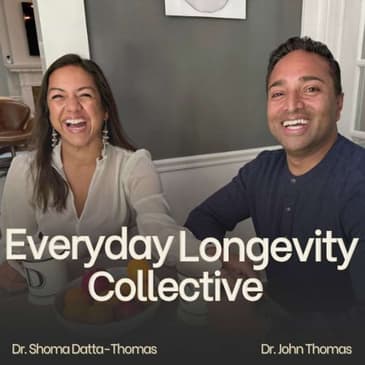
Welcome back to the Everyday Longevity Collective podcast. In this episode, Drs. Dr. Shoma Datta-Thomas and Dr. John Thomas tackle the foundational question of nutrition for healthy aging and performance: how do we truly fuel ourselves for longevity? With no shortage of conflicting dietary advice out there, they cut through the noise, focusing not on trendy frameworks, but on fundamentals supported by robust evidence and new personalization tools.
From the critical importance of protein intake as we age, to the evolving science behind fats and carbohydrates, the episode explores practical strategies for every decade of life. The hosts answer listener questions about blue zones, fasting, and supplementation, highlighting how individualized nutrition–not one-size-fits-all–is key. You'll learn actionable takeaways you can implement this week, and why consistency, quality, and timing matter more than ever. Whether you're optimizing performance, protecting long-term health, or just aiming to feel your best, this episode is your guide to building a nutritional foundation that lasts.
00:00 Struggles with overwhelming nutrition advice
08:24 Optimizing protein for active lifestyles
10:27 Hormones, aging, and muscle preservation
15:26 Using CGM for health insights
16:23 Blue zones and longevity factors
20:40 Popular supplements and nutrition gaps
26:42 Metabolism changes in midlife
28:12 Nutrition priorities for aging
33:52 Carbohydrates for daily fuel
38:38 Healthy fat intake guidelines
41:05 Understanding insulin and cholesterol
43:42 Creatine dosage recommendations
Fuel and Foundation: Key Nutrition Insights for Longevity
If you’ve ever scrolled endlessly through nutrition advice online finding everything from keto to plant-based to intermittent fasting championed as a magic bullet, you’re not alone. As Dr. Datta-Thomas and Dr. Thomas emphasize in Episode 6 of the Everyday Longevity Collective, “Fuel and Foundation,” there’s no shortage of information, but most of us still feel like we’re guessing about what our bodies truly need. This episode cuts through the noise to focus on the fundamentals and the growing role of personalized nutrition.
The Power of Protein (and Why It’s Undervalued)
If there’s one nutritional lever most underutilized, Dr. Thomas says, it’s protein. While the Recommended Dietary Allowance (RDA) sets a baseline for deficiency prevention, active adults, especially those wanting to maintain or build muscle as they age need considerably more. Clinical advice: target 0.7 to 1 gram of protein per pound of body weight. This isn’t just theoretical. Robust research published in the British Journal of Sports Medicine confirms that a higher protein intake, coupled with resistance training, meaningfully boosts muscle mass and strength 08:59.
Why prioritize muscle? It’s metabolically active tissue that supports immune function, blood sugar management, and overall resilience. Aging “naturally” involves losing muscle, but this isn’t set in stone. Both nutrition and training can shift this trajectory if you get enough protein.
Hormones matter too. As Dr. Datta-Thomas points out, declining hormone levels beginning as early as the 30s mean muscle preservation requires even more deliberate effort 10:42. Many are told to simply “eat less,” when in fact, a protein focus becomes critical.
Fat and Carbs: What Really Matters
For years, the advice was to cut dietary fat for heart health. Now, Dr. Datta-Thomas explains, research clearly shows that the type of fat matters most. Fats are building blocks for cell membranes and hormones, very low-fat diets can actually disrupt hormone balance, especially for women 13:02. Unsaturated fats (found in olive oil, nuts, fish) and omega-3s are repeatedly linked to reduced inflammation, better cardiovascular health, and even improved recovery 13:27.
Carbohydrate tolerance is highly individual and changes with age, hormone status, and activity level. New tools like continuous glucose monitors (CGMs) now allow real-time tracking of your body’s unique response to different foods 14:03. This is especially useful during times of hormonal transition, like perimenopause, and helps fine-tune both your carb quality and timing.
What About Fasting, Blue Zones, and Supplements?
Hot-button questions get frank discussion. Blue Zone populations, treasured for their longevity, do tend to eat less animal protein, but, as Dr. Thomas clarifies, those communities also move more, experience less stress, and avoid ultra-processed foods. Diet is a piece, not the whole puzzle 17:09.
Intermittent fasting can be helpful for some, but extended fasting windows aren’t universally beneficial, especially for women during perimenopause and menopause, who may experience more adverse effects due to hormone shifts and increased stress 18:52. Data is strongest for a simple 10-12 hour overnight fast for most people.
Supplements? Dr. Datta-Thomas is clear: fill gaps, don’t replace a nutritional foundation 20:44. Common recommendations include vitamin D, magnesium, B12, and omega-3s. Creatine, surprisingly, is highlighted for its benefits beyond muscle: aiding cognition and especially supporting women as they age 22:44. Always choose third-party tested products, and when possible, test for deficiencies before piling on pills 24:08.
Nutrition Across the Lifespan
Youth/Teens: Prioritize fueling for growth and movement, not just performance, but healthy food relationships 24:41.
30s/40s: Focus on recovery with adequate protein, anti-inflammatory foods, and blood sugar control. Get tested for fasting insulin, not just glucose 26:47.
50s and Beyond: Shift your outlook to maintenance bone density, cognitive health, nutrient absorption. Appetite may wane, but micronutrient needs remain 28:12.
Simple Weekly Actions
Make protein the focus of breakfast for steady energy 29:30.
Get key labs (fasting insulin, vitamin D, micronutrients) 30:14.
Add omega-3s and fiber from diverse, whole food sources 30:34, 37:35.
Time carbs around movement and prioritize food quality 31:11.
Consider a short CGM trial for personalized data 31:38.
The Bottom Line
Dr. Thomas closes with a reminder: what you eat determines how well you move, recover, and age. Nutrition is your most accessible tool for long-term health. Consistent, evidence-based choices tailored to your biology are the foundation. Start now, whatever your age, and your future self will thank you.
Show's Website - https://everydaylongevity.co/
Dr. Shoma Datta-Thomas LinkedIn - https://www.linkedin.com/in/shomadattamd/
Podcast Partner - TopHealth - https://tophealth.care/
“Disclaimer: Informational only. Not medical advice. Consult your doctor for guidance.”
You can find a compelling argument for almost any dietary approach. And yet, despite all this information, most people still feel like they're guessing. So if there's one nutritional lever consistently underutilized across almost every patient population I work with, it's protein.
SPEAKER_00This is the window where we often see those in middle age or midlife being told to eat less when actually what they need is just to eat differently. And specifically to prioritize protein in a way they may have never had to before. It's about being consistent with your nutritional fundamentals, understanding your own biology as well as you can, and making choices that compound over time.
SPEAKER_01The decisions you make about nutrition today are writing the story of your body and what it's capable of in your 70s.
SPEAKER_00My name is Dr. Shoma Dada Thomas, and I'm a board certified OBG Mayenne of 20 years, as well as a minimally invasive surgeon, now practicing as a longevity physician and the VP of medical operations of a national longevity company.
SPEAKER_01Hi, and I'm Dr. John Thomas, a sports performance chiropractor and exercise physiologist with private practice for the last 25 years.
SPEAKER_00Today's episode number six is nutrition fuel and foundation.
SPEAKER_01And there is no shortage of nutrition information in the world right now. Podcasts, books, social media. You can find a compelling argument for almost any dietary approach. And yet, despite all this information, most people still feel like they're guessing. They're not quite sure what their body actually needs or what and why that actually works for someone else and why it might work for them.
SPEAKER_00That's exactly the gap we want to address today. Not another diet framework, but the fundamentals the evidence consistently points back to, and some of the newer tools that are helping us personalize nutrition we couldn't even think of even five years ago. What John and I try to do, both clinically and even in conversations like this, is to help people understand their own biology so they can make choices that are actually relevant to them.
SPEAKER_01And before we get in, a quick but important note is that everything we discussed today is meant to be educational. We want to give you the context and the questions to bring to your own medical professional. We are not your personal doctors, and individual health decisions should always be made in partnership with someone who knows your full picture. With that said, let's get into it.
SPEAKER_00Okay, first up, protein, the foundation that everyone underestimates.
SPEAKER_01If there's one nutritional lever consistently underutilized across almost every patient population I work with, it's protein. The recommended dietary allowance was set to prevent deficiency in sedentary individuals, a floor, not a ceiling. So what the more recent sports science literature tells us is that in active adults, people who are training, recovering, and trying to maintain or build muscle as they age, optimal protein intake is considerably higher than that baseline. So the number I use clinically is roughly 0.7 to 1 gram per pound of body weight. And the research supports this more consistently.
SPEAKER_00A meta-analysis in the British Journal of Sports Medicine looked at over 1,800 participants and found that higher protein intake combined with resistance training produced significantly greater gains in muscle mass and strength. For active adults, this isn't a fringe finding, but one of more robust data sets in what we have in nutrition science.
SPEAKER_01The reason this matters so much as we age is that muscle itself is metabolically active tissue. It supports immune function, glucose management, strength, and injury resilience. So losing it is an inevitable part of aging. It's something we can significantly influence through both training and nutrition, but you cannot build or preserve muscle in an adequate way without protein. So it is raw material and that's a full stop.
SPEAKER_00From the hormonal side, which can start even in our 30s, noticing a drop in hormone levels, muscle preservation becomes a much more active effort. The hormone environment that previously helped maintain muscle mass is now shifting. So nutritional support has to compensate that much more. This is the window where we often see those in middle age or midlife being told to eat less when actually what they need is just to eat differently and specifically to prioritize protein in a way they may have never had to before.
SPEAKER_01And there's some also some evidence in older adults that's worth highlighting. A randomized control trial in the Journal of American Medical Directors Association found that protein supplementation significantly increased muscle mass in frail elderly individuals doing resistance training compared to the placebo. So the biology is responsive at any age, but the finding reinforces the case for not waiting.
SPEAKER_00Practically, protein at every meal is the simplest framework. Breakfast, especially where most people's intake drops off. Eggs, Greek yogurt, cottage cheese, more accessible options that really make a difference. Post-training, especially within about an hour, is when muscle protein synthesis is the most responsive. And for people with busy schedules, a protein supplement is a practical tool, not a compromise. Plant-based approaches are also completely workable, but they require a little bit more intentionality around combining sources and tracking intake and at least to understand your baseline.
SPEAKER_01So the next part we're going to cover is fat, carbohydrates, and what we've learned in that process.
SPEAKER_00So when we think of dietary fat, the science here has genuinely evolved, and it's worth talking through that thoughtfully. For several decades, the prevailing guidance was to reduce fat intake as a strategy for heart health. But that guidance really came from a place that reflected the best understanding at that time. Now, what we've understood and come to appreciate is that the type of fat matters considerably more than the total amount. So one thing that doesn't come up enough is that the cholesterol in our bodies is actually our precursor or our fuel for every sex hormone the body makes. Estrogen, progesterone, testosterone, all begin as cholesterol. Very low fat intake can have downstream effects on hormone health, particularly in women that are worth understanding. This also applies to all of our cell membranes, nerve maintenance. It's a really big issue that we can see where cholesterol is a true benefit.
SPEAKER_01And the evidence on omega-3 fatty acids is one of the clearest findings across the research. This is found in fatty fish, walnuts, flaxseed, and quality fish oil. The data on omega-3s for inflammation management, cardiovascular health, and recovery is genuinely consistent. So I recommend omega-3 supplementation to a significant portion of my patients, especially over 40, not as a trend, but because the evidence is strong and the downside risk is essentially negligible.
SPEAKER_00And speaking of carbohydrates, the tolerance here is not uniform. It really varies by individual, age, hormone status, definitely activity level, and even time of day. So two people eating the same meal will meaningfully have different responses. So we haven't really historically had good tools to monitor that until more recently, where now we can use a continuous glucose monitor to track that specific and individual response. I find this is very helpful, especially in those middle age years or again, midlife years where hormone transition can be very active and having a lot of rapid transition. So you can find where food can drive meaningful excursions, meaning unexpected peaks or spikes in your levels to support your process.
SPEAKER_01Right. And for athletes, CGMs reveal things that change how people train and eat. Exercise itself, high-intensity work in particular, can cause a temporary glucose rise even without eating. Understanding that pattern helps people time nutrition more strategically around training. It also identifies underfueling because you can see that glucose drops, that explains the flat performance and slow recovery. Well, the practical carbohydrate framework stays straightforward. Whole food sources, oats, sweet potato, legumes, whole grains, these are all keys, and then time them around physical activity when insulin sensitivity is naturally higher. But a short CGM trial can definitely take you that general guideline to general personalization.
SPEAKER_00One CGM monitor typically lasts about two weeks. So we usually say, unless you're, if you're just doing this for maintenance a few times a year, doing that exercise is really helpful. If you're course correcting based on some biomarkers or some recent symptoms or changes in your health, then you can incorporate a little bit more frequently. In general, we now understand that carbohydrate quality matters, timing matters, and what works for your specific metabolism is something you can actually now measure. So that's a meaningful shift, even from where we were a few years ago.
SPEAKER_01So in regards to your carbohydrates, we want to make sure that you're getting the right amount of carbohydrates to fuel you throughout the day. Now, here we're not just talking about feeding your urges, it's about feeding your movement. We want to make sure we're taking in necessary carbohydrates to fuel you through your day and to start your day that way with nutritionally dense carbohydrates. So non-processed, not simply your refined carbohydrates are your key. And using them before activity is also useful. That's when you're going to utilize them the most. And they won't enter your blood sugar and give you that spike. And also, if this is also a good time, if you need that sweet treat, I'll usually treat myself before exercise, where I can get the most, you know, get that craving handled, but my body will be able to utilize that sugar for energy right away, and I won't store it.
SPEAKER_00And one consideration that's important here is our fiber intake. This is one of the simplest, most evidenced back flavors we can have for longevity. Adults generally should aim for 25 to really closer to upwards of 40 grams from a daily mix of whole food sources. So this is soluble fibers, thinking of oats, beans, flaxseed. They feed the gut microbiome, stabilize blood sugar, and they can help support healthy levels of cholesterol and hormone metabolism. So this is also an important area I always point out is how we clear excess estrogen in males and females. Insoluble fiber comes from vegetables, whole grains, and nuts. These will keep the digestive system moving efficiently and consistently. And this is one area we can further support our cardiovascular health, insulin sensitivity, again, that diverse microbiome that is helping our whole system metabolize. These are all core pillars of how well and how long we live.
SPEAKER_01When we talk about fat, let's make sure we're getting about 20 to 35% of our total daily calories from it. Let's make it a quality types of fat. We're focusing here on unsaturated fats like olive oil, nuts, and fish, like we spoke about. You want to really limit your saturated fat to less than 10% of your total calories. So that would be less than 20 grams a day in like a typical 2,000 calorie a day. And make sure you avoid trans fats as much as possible. There's nothing good there for you. They're only going to make a difficulty for your body to process the rest of the food that you're trying to get nutrition out of. But my general rule for fiber is you want to get about 14 grams of fiber per 1,000 calories. So depending on how you're managing your calorie count, try to get, again, about 14 to 15 grams per thousand calories. And so that'll give you a good estimate if you're getting enough. But again, like starting protein in the day, try to start with a nice glass of water and potentially some fiber. This will help keep you satiated to start your day and throughout maintaining energy throughout your day. And then when we speak about fiber, let's add fiber from forms like fruits, vegetables, beans, and whole grains. You want to make sure you get these healthy fats from avocados, meats, nuts, seeds, and fish, like we talked about. And the balance is key. Don't go extremely low or high on fat unless medically advised.
SPEAKER_00When we're thinking of using the CGM to measure our blood sugar response, essentially we're optimizing our insulin function. And I always want to make a small note about how insulin can influence important issues like our cholesterol. So when our insulin is working properly, it keeps the liver from overproducing harmful fats and maintains a healthy cholesterol balance. But when cells stop responding to insulin, called insulin resistance, this is when we see triglycerides rise, HDL, the good cholesterol, drop, and LDL, the bad cholesterol, becomes smaller and denser. And that makes it more damaging to our arteries. The tricky part here is that standard cholesterol panels may look relatively normal even when this harmful pattern is developing. So this is why we want to make sure we are maintaining very close check on our insulin sensitivity and getting more elevated and expanded cholesterol panels, which include our apolipoprotein B and the genetic disposition for increased risk of LP little A. So actually, insulin sensitivity is one of the most direct ways to protect your heart and arteries at the root level.
SPEAKER_01When you're planning your protein for the day, spread it across all your meals, right? And for trying to get 30 grams in the breakfast, try to get, you know, somewhere between 20 to 40 grams per meal is a good target for each meal. That way you'll hit your goal of somewhere between 0.8 to 1 gram per pound of body weight for a good active individual. Try to get those proteins in lean meats, fish, eggs, dairy products like Greek yogurt or quality grass-fed milk, and then plant sources like beans, lentils, and tofu. All these are good sources of getting that protein in throughout your day. Again, it will aid in maintaining muscle, maintaining satiety throughout the day, and maintaining your energy and glucose level so that you're consistent throughout your day. When it comes to recommendations for creatine, I usually recommend about five grams per day, up to about 10, depending on your level of activity, your need of mental focus, your level of work. It also helps if you're overly fatigued or tired. It will help with your cognitive function. So I'd like to, I'll supplement a little heavier if I'm a little bit low on sleep that day. It'll help me function throughout my day where I'm have a little more clarity of thought.
SPEAKER_00We also know creatine is a major supporter for our gut health. This is, of course, again, where we have that really careful balance of our microbiome and also our absorption of our micronutrients. So another great benefit of creatine. All right, our next segment: questions we get asked. We wanted to bring you answers that we are talking about behind closed doors, sometimes with our own patients, family, and friends.
SPEAKER_01First question here is that we get often asked is what about the blue zones? Centenarians eat very little meat. So this comes up constantly when we talk about protein, and it's a fair question. The Bloom Zone's data, communities with exceptional longevity in Sardinia, Okinawa, Loma Linda, and others, does show populations eating relatively low animal protein who live remarkably long, healthy lives. But here's what I think in that key context is those populations aren't just eating differently, they're living completely differently. So daily physical movement woven into the fabric of life, deep multi-generational social connections, a low chronic stress, and lifelong absence of ultra-processed foods are really keys to that. Diet is one of, is just one variable in such a much larger system. And when we isolate it, we lose the most important part of the big picture.
SPEAKER_00And what we do see in these populations is while their animal protein intake may be lower, their other sources of protein are very robust. So let's say sardinians and pecorino cheese. In Lama Linda, there's a heavy legume intake. So these are important considerations as well. The next question that we wanted to discuss was fasting. Intermittent fasting or longer fasts is something that comes up a lot. And is this the same for everyone?
SPEAKER_01Intermittent fasting is one of the most discussed nutritional tools of the last decade. And the research on metabolic flexibility and glucose regulation is genuinely interesting. A compressed eating window can be a useful strategy for some people in some contexts, but the evidence does not support a one-size approach. And the sex-based differences here are real and significantly underreported. Because much fasting research has been conducted in men or mixed populations where sex disegregated data wasn't the focus.
SPEAKER_00What we see is while intermittent fasting can help limit calories or general intake and can help with glucose tolerance for many, there is some more emerging data regarding specifically women in perimenopause and beyond. We see the response here can be quite different with extending fasting windows. And while for some a compressed eating window can generally improve the glucose stability and metabolic flexibility, we have to keep in mind that you want to understand your own data because those often managing more hormone fluctuations, disrupted sleep, elevated baseline stress, pushing a very long fasted window can further elevate the stress response and elevated cortisol. So that can end up being counterproductive.
SPEAKER_01From the performance and muscle preservation side, training fasted has a place in some protocols for some goals, but chronically underfueling around training, which extended fasting windows can cause inadvertently, undermines the adaptation you're training for. So if you're trying to build or preserve muscle while running a 20-hour fast, you're working against yourself. My clinical framing is a natural 10 to 12 hour overnight window is a reasonable baseline for most people. Beyond that, it's a tool that should be matched to the individual. And the CGM is actually a useful way to assess whether your fasting window is improving your glucose stability or just stressing your system.
SPEAKER_00Okay, another very popular question. What supplements should I actually be taking? The honest truth here is I end up removing supplements these days more from protocols than adding them because we are marketed and hearing about so many different types of supplements, it's hard to know what's actually relevant. The honest answer is supplementation should be filling gaps, not replacing any foundational nutrition. But there are some that I will bring into protocols very commonly. And generally, this is more involving vitamin D, magnesium, omega-3s, and B12. Vitamin D especially extraordinarily prevalent in deficiency, even if you are spending a lot of time outdoors, and this has tremendous effects systemically on our immune function, our bone health, our mood, hormone signaling. Magnesium also is very extensively involved in over 300 enzymatic reactions. Sleep quality, blood pressure, muscle function, blood sugar regulation, they can all actually be tied into magnesium. So these are the few that I will pretty consistently incorporate for many routines. I will say with supplementation, if you have the opportunity to test your micronutrient levels, that really gives very specific guiding and the ideal way to do it.
SPEAKER_01We already talked about omega-3s and their anti-inflammatory case is strong, and the bar to supplement is low. So I'd add creatine here because the evidence for creatine and muscle preservation, cognitive function, and healthy aging has become remarkably consistent over the last several years. It's one of the most researched compounds in sports nutrition, and the benefit now extends well beyond athletic performance, particularly for adults over 40 and women in menopause transition. It's a supplement I recommend broadly in that population and above. When we think about supplementation, quality matters. Look for third-party tested products, NSF certified for sport or USP verified are reliable markers. What's on the label should be what's in the bottle, which is a higher bar than it sounds in this space.
SPEAKER_00Yeah, absolutely. All right, so let's talk about nutrition across the lifespan. And so we'll start, similarly to how we staged out our movement episode, we'll start through the different decades of ages.
SPEAKER_01Something underserved in the youth sports space is adequate fueling. We have young athletes training at serious intensities without nutritional support to match. The result is fatigue, slower recovery, and in some cases, stress injuries that trace back to low energy availability. The body not having enough fuel to support both training and growth simultaneously is what leads to this. If a teenage athlete is persistently tired, underperforming, or getting injured repeatedly, underfueling is one of the first things we're worth examining.
SPEAKER_00And we think about this a lot as parents, the psychological dimension. The relationship a young person develops with food has long-term consequences. So we try to frame food around what it does. It helps build muscle, it helps fuel a workout, helps your brain focus. We want food to feel empowering, not fraught with guilt or shame. Because of the complicated relationships we sometimes see with our patients, with eating, we know that this can trace back to messages absorbed in childhood and adolescence. So we do take that seriously.
SPEAKER_01When we hit your 30s and 40s, where nutritional strategy becomes really critical. The 30s and 40s are where I see the nutritional influence on recovery most clearly. Patients who prioritize protein, who eat anti-inflammatory foods, and manage blood sugar respond to treatment faster and more completely. It's one of the most consistent patterns across 20 years of practice. And when patients are doing everything right and still not getting results, the nutritional variable is often the first place I'll look before assuming the problem is something else.
SPEAKER_00Clinically, this is a very important decade for metabolism and hormone transition. In the randomized trial in power published in PLOS 1, researchers looked at midlife women with weight gain and completely normal fasting glucose. Over 62% had elevated fasting insulin that had gone undetected. Because standard panels really check glucose, not insulin. So a carbohydrate modified diet alone produced significant weight loss as Months. No medication. Just a more targeted nutritional strategy once the actual metabolic driver was identified. So this is where, again, a conversation with your doctor about the appropriate testing for you, I often will pretty actually a standard will include a fasting insulin. This can be meaningful context for patients in addition to the routine panels.
SPEAKER_01But next we hit our 50s and beyond. So protection and the long game. The compounding return on nutritional investment in this decade is something I want to name clearly. People in their 60s and 70s who have built a strong nutritional foundation move and function in ways that look like someone a decade or more younger. They're not outliers, they're the product of consistent choices made much earlier. The decisions you make about nutrition today are writing the story of your body and what it's capable of in your 70s. But that's not a metaphor, that's physiology.
SPEAKER_00As we move into the 50s, 60s, and beyond, nutritional priorities really shift towards biological protection. So thinking of our bone density, cardiovascular resistance, cognitive health. Nutrition absorption tends to be less efficient as we age. So dietary volume may decrease, may not have as big an appetite. And certain medications in this age group can further promote that and cause depletion in specific nutrients. So again, thinking of vitamin D, magnesium, B12, calcium, omega-3s, these are important ones to address consistently, but they're correctible deficiencies. It's just important not to miss them. So this is worth the specific conversation with your doctor and medical team as well.
SPEAKER_01All right, so let me give you some quick takeaways. Things that you can actually do this week, and I'll start with protein at breakfast. Every day, your morning meal sets the metabolic tone for the whole day. And most people, breakfast is essentially a carbohydrate delivering system. Eggs, Greek yogurt, cottage cheese, pick one of them and make it a default. You want to try to get at least 30 grams in the morning. It'll set you up for a much sustainable day where your energy is much more level and you're not riding that roller coaster of ups and downs.
SPEAKER_00You can also think about which labs may be helpful to complement your nutritional protocols and priorities. Again, a fasting insulin can be very helpful here and may pick up insulin resistance even before a glucose or a hemoglobin A1C would.
SPEAKER_01Again, remember we're adding omega-3s, fish oil, fatty fish twice a week, or both. The anti-inflammatory evidence is consistent. The downside risk is negligible, and most people aren't getting enough through diet alone.
SPEAKER_00And get vitamins such as vitamin D checked. Micronutrient testing for you can give you particular protocols that are individualized and create the long-term success.
SPEAKER_01And remember to time your carbohydrates around movement earlier in the day, around training, when insulin sensitivity is naturally higher. It doesn't require dietary overhaul, just a shift in your timing.
SPEAKER_00If you're adding supplements to your diet, make sure you're getting third-party tested products and build a focus stack for you rather than a cluttered one.
SPEAKER_01And then consider a short CGM trial. Two or four weeks of real-time data on your own glucose response is worth more than a year of generalized ad advice, right? So ask your provider whether it makes sense for your situation.
SPEAKER_00And always think protein first, food quality second, timing third, in that order. When those three are right, the rest take care of itself.
SPEAKER_01So that's the list. Not complicated, just consistent, right? Start it and make it a habit.
SPEAKER_00All right. So what we want to leave you with at the end of all this is the thought that nutrition is the most accessible and most powerful tool we have for long-term health that we can tap into on an everyday basis. Not because clinical interventions don't have a place. They absolutely do, but because nothing works optimally again without your foundation. And building that foundation isn't about following the most sophisticated protocol or huge stack of supplements. It's about being consistent with your nutritional fundamentals, understanding your own biology as well as you can, and making choices that compound over time.
SPEAKER_01And I'll close with the frame I keep coming back to. What you eat determines how well you move. So your muscles, your tendons, your joints, your recovery capacity, all of it is built from nutritional raw materials. Movement and nutrition are not two separate conversations. They are the same conversation. They all build on each other. And the story you're writing with those choices you make today is the story your body's going to tell 10, 20, and 30 years from now. So make good choices and you'll appreciate them down the road.
SPEAKER_00It's never too early or too late to get started and focus on your own nutrition. Our movement episode is already out. So if you go back and listen to that alongside this one, you'll see they're designed as companion pieces. If today's episode was useful, share it with someone who could use this framing, leave us a review, and send us any questions you want us to tackle next. The questions we get asked segment exists because of what you send in. So we appreciate it and keep it coming.
SPEAKER_01So take good care of yourselves. We'll see you on the next one. We look forward to the next conversation.